Read time: 5 minutes
TLDR: I caught Covid, but meditation has helped me stay happier despite the discomfort
- Background:
- Blah Blah Blah…(Illness and the Effects of Vipassana):
- Pulling up Past Reactions (Sankaras)
- A Good Test for Future Old Age
- A Story on the Pains of Old Age – Goenkaji’s Mother
- Some Things that Have Helped Me…
- Closing Thoughts:
Background:
Hello Readers!
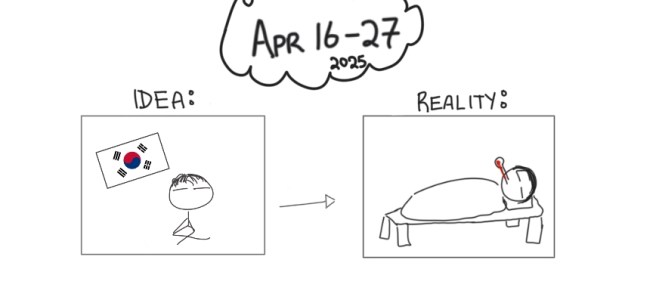
Despite my little picture and memos to family and friends saying I’ll be away until April 27th serving at Dhamma Korea, my serving experience was cut short because I caught Covid. Ah well. What can you do? Luckily it’s quite mild with just some foggy brain, aches and pains plus a low grade fever on occasion. I was a little concerned about where I’d go initially, but things really tend to work out these days. An old meditator student lent me their empty home while I recover so no need to worry about infecting others or financial hardships. Plus…it’s only a 5 minute drive back to Dhamma Korea when I’m back to proper health. Thank you Dhamma!
Blah Blah Blah…(Illness and the Effects of Vipassana):
To be honest, I’m not sure what to talk about. My brain is a bit foggy which makes it hard to consolidate thoughts so I guess I’ll just blabber on and see what happens. (Please forgive the lack of flow of the post).
It’s been interesting having an illness since starting vipassana. Why? Well, in the past when I was sick, my thoughts and physical ailments used to overwhelm me a lot. I’d start rolling in unhappiness:
“Why am I in pain?” “Oh this sucks” “Why can’t I feel better” “Oh I wish I was better” “Uggh. It’s too cold.” “Ugghhh it’s too hot”
Just reading the above sentences again makes me feel unhappy! With vipassana now in my toolbelt, although I still don’t feel well, at least I’m not compounding my unhappiness as much. I’m more able to snap out of it and simply observe the unpleasant sensations.
“Oh…there’s some pain here…and it leaves…oh…there’s pain elsewhere now…and it left too…” “Oh…I’m nauseous. Does it stay consistently the same or does it change?” “Oh look…it’s gone…now…it’s back”
The whole point of vipassana is to develop an experiential understanding that everything is impermanent so why react. Before I used to think that pain was just constant, but now with a bit more awareness of the subtle changing sensations on my body, I can see (at times) that the unpleasantness is actually not a continuous stream. Instead, it comes and goes.
Pulling up Past Reactions (Sankaras)
Now that isn’t to say that this awareness is perfect. In fact, what I’ve learned from this time being ill is that the old habit patterns are still there ready to make themselves known. I notice that while I’m sick, it’s easier to lack motivation, feel numb, sad or get irritable. It’s more challenging to remain equanimous and remember that thoughts are simply just old habit patterns of my mind. When I’m well, it’s so easy to believe that I can remain equanimous, but once illness hits, that’s simply the real test.
A Good Test for Future Old Age
I’m very fortunate that along this vipassana journey that I’ve met many old students. I speak with one of them about how we’re excited for old age because by that point we’ll have had many more years of vipassana under our belts. Hilariously, we both also laugh because when we get ill, our equanimity slips and we’re like “Oh ouch! that hurts!”.
Ah…more meditation and growth to be had…
A Story on the Pains of Old Age – Goenkaji’s Mother
More on that note, part of the reason I want to continue practicing this meditation is that I’ve read so many inspirational stories about older students during their time of passing. Many have great pains, cancer, loss of friends/loved ones, yet their minds remain so stable. When the mother of Goenkaji (the main teacher) was dying, she described her pain to be “similar to that which a mother suffers when she gives birth – except…no break”. Despite the pain, her doctors would comment how she would always greet them with a smile.
When I read this story the first time, I remember feeling so inspired. If I practice enough, I won’t be so grouchy toward to my family when I’m ill! Maybe I could instead greet them with a smile and not just complaints about how unwell I feel.
(More of these wonderful inspirational stories can be found in The Art of Dying.)
Some Things that Have Helped Me…
- Obviously Meditation
- Even when I’m tired or in pain, when I notice I’m becoming negative, the sitting twice or even three times a day has been really helpful during this time. Sometimes, it’s too much to do vipassana so anapana has been wonderful in rebalancing my mind
- Virtual Group Sittings
- With more pain and a foggy mind, it’s harder to concentrate. It’s also more easy to get frustrated that I can’t concentrate or remain equanimous. The virtual group sittings (especially ones with an AT present) have been really helpful in refocusing me. I’ll ask questions (if there’s an AT present) and their answers of “accepting reality as it is” has been a good reminder.
- They’re available on the app or you can check out this blog post which has the English virtual group sittings in a Calendar. Highly recommend the California Group Sit (7am/7PM PST). Well-established and many people ask questions so it’s a wonderful place to learn.
- Remote Dhamma Work
- When I feel well enough, sometimes I can do some remote Dhamma work for the Dhamma App or another vipassana centre. It surprisingly gives me more energy and makes me happier.
- If you want remote Dhamma work, there’s never any shortage! Just check with your local Dhamma centre or use the “contact us” button on the Dhamma App to reach out.
Closing Thoughts:
Lastly, there’s a phrase I came across many years before Vipassana:
“Pain is inevitable, but suffering is optional.”
I stuck this on my wall for many years as a reminder and, while I understood it, I couldn’t put the teaching into practice.
Now I can say thank you Vipassana Meditation and my teachers for helping me to gain this understanding.
With much metta,
Tracy
 World of Wandering Minds